
For most new academics, a thesis or dissertation is the longest document that you have produced so far in your life. The content of the dissertation is challenging enough, but its formatting and style are also challenges.
Successful dissertation writing requires mastery of an academic style manual, compliance with particular instruments from your university and degree program, and advanced skills with Microsoft Word. (Or possibly another word processing program, but don’t choose something else without a very good reason. Ask me how I learned this lesson!)
Producing the final document can resemble a logic game illustrated in this diagram:
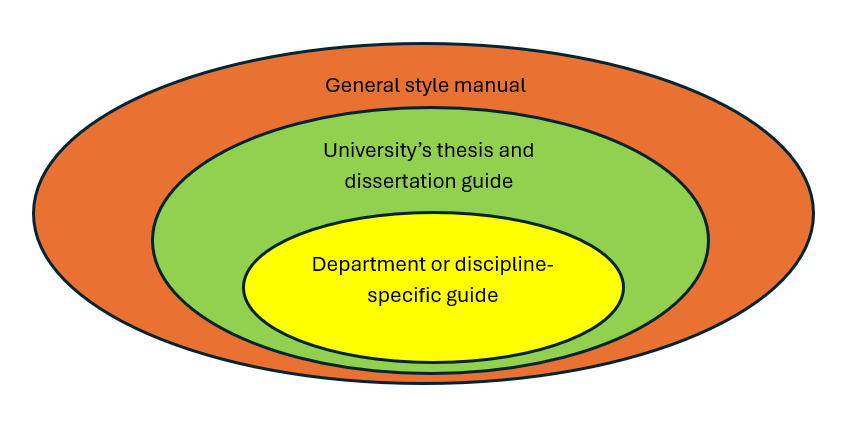
Your program may instruct you to begin with a general style manual such as the APA Publication Manual or the Chicago Manual of Style. But then the university’s office of theses and dissertations might have its own style guide, and some of its instructions might take precedence. Then there may be a style sheet specific to your own discipline, which might require you to modify particular instructions in the published manual or the university’s style guide.
In other words:
- First there are the basic rules (APA or Chicago style).
- Then there are exceptions to the rules (what the thesis and dissertation office requires).
- Then there are exceptions to the exceptions (matters specific to your own field or degree program).
This is a lot to keep track of, even if you are writing in your first language. If you’re writing in a second language, it’s even harder.
Microsoft Word has functions that can help you with some of this process: styles, sections, table of contents, lists of tables/figures, footnotes, citations, and bibliographies. Taking advantage of these functions requires advance planning. It is far easier to implement formatting early in the process of creating a document than it is to make changes to the formatting of an almost complete document on the eve of submission.
Every Word user can tell you horror stories about spacing that refuses to behave, text that mysteriously looks different from the rest of the document, or tables that seem to change in appearance each time the document is opened. In many cases, these problems are caused by failure to attend to Word settings early in the process of creating a document, particularly when merging content from multiple files. You don’t want to have to deal with such an issue the day before your dissertation is due!
Some universities and programs allow their degree candidates to consult with an outside editor for assistance with these rigorous publishing standards, as well as for assistance with writing in English for an academic audience. If you are looking for an experienced editor who can help you to bring your document to completion, you may wish to learn more about my business, Allegretto Editing.

 Duncan Vinson